The USDA ADU loan, explained plainly
USDA has finalized a rule that lets its Guaranteed Loan Program finance a single-family home with one or more income-producing accessory dwelling units. Here's what changed, who it applies to, and what nobody knows yet.
What the USDA ADU rule changes
The USDA Rural Housing Service published a final rule in late October 2026 that changes how its Single Family Housing Guaranteed Loan Program treats homes with accessory dwelling units. Starting December 28, 2026, the program can finance a single-family home that has one or more income-producing ADUs.
That is a real shift. Under the old rules, a home was ineligible if its ADU had produced rental income, even if the buyer had no plans to rent it out. A house with a backyard cottage, a garage apartment or a basement suite that a previous owner had rented could be ruled out simply because of that history. The new rule removes that barrier.
In one sentence: a home no longer fails USDA Guaranteed Loan eligibility just because it has an ADU that earns, or has earned, rental income.
The rule does two other things. It adds formal definitions of an "Accessory Dwelling Unit" and a "Living Unit" to the program regulations at 7 CFR 3555.10, so lenders and appraisers have a shared standard. And it clarifies that homes with features for home-based businesses can stay eligible, as long as those features don't require commercial real estate.
Who the rule applies to
The rule amends the Guaranteed Loan Program. In that program, the loan itself comes from a private, USDA-approved lender, such as a bank, credit union or mortgage company. USDA guarantees the loan, which is what lets lenders offer it on USDA's terms.
The rule does not describe changes to USDA's direct loan program, where USDA lends to the borrower itself. If you are looking at a direct loan, don't assume the ADU change applies to you until USDA says so.
Because guaranteed loans come from private lenders, this is also why you can't apply "with USDA" for an ADU home. You apply through a participating lender, and each lender has to update its own process once USDA publishes the details it needs.
What counts as an ADU under the rule
The rule adds definitions of an Accessory Dwelling Unit and a Living Unit to 7 CFR 3555.10. The key practical test is what makes a space a living unit. Under the rule, a living unit needs all of the following:
- Potable (drinkable) water
- Sanitary facilities
- Heating
- Electricity
- At least one bathroom
- A kitchen or a kitchenette
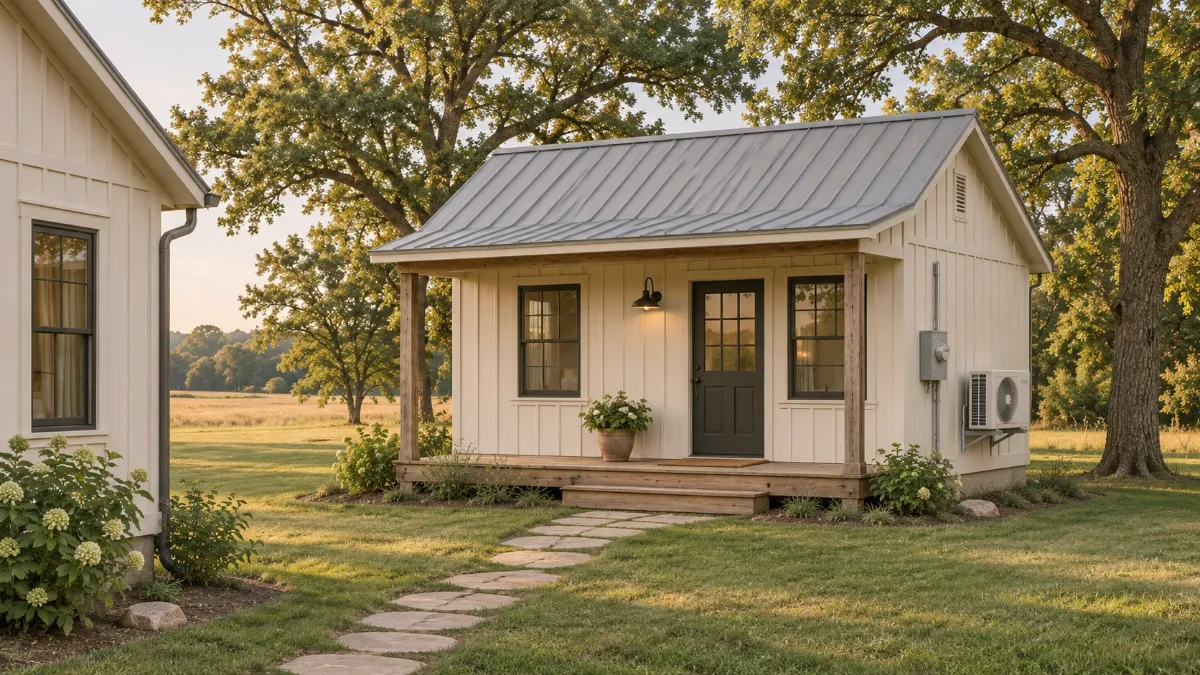
In everyday terms, that covers the kinds of spaces people usually mean by an ADU: a detached guest house, an apartment over a garage, or a self-contained suite inside or attached to the main home, as long as it has those essentials. A bonus room with no kitchen or bathroom is not a separate living unit.
Homes with home-based business features
The rule also clarifies a question that has tripped up some rural buyers. A home with features for a home-based business, such as childcare, product sales or crafts, can remain eligible, provided those features don't require commercial real estate features.
The line is about the property, not the activity. A home where someone runs a small business is still a home. A property that needs commercial-grade features to support that business is a different matter, and the rule keeps that distinction in place.
What we don't know yet
A final rule sets the policy. The day-to-day details lenders use come later, usually through USDA's program handbook. Until that guidance is published, some of the most important questions don't have answers. We'd rather tell you that plainly than guess.
| Question | Status |
|---|---|
| Can a Guaranteed Loan finance a home with one or more income-producing ADUs? | Yes, from December 28, 2026 |
| Does the rule define an ADU and a living unit? | Yes, in 7 CFR 3555.10 |
| How does ADU rental income count toward qualifying for the loan? | Not yet known |
| Can the loan pay to build a new ADU? | Not yet known |
| When will lenders start offering it? | Not yet known |
| Does it change the direct loan program? | Not described |
Be careful with anyone quoting firm numbers. If a website or ad tells you exactly how much ADU rent will count toward your income, ask where that comes from. As of November 2, 2026, USDA has not published that guidance.
How we got here
Proposed rule published
USDA proposed the change in the Federal Register (FR Doc. 2026-06173).
Public comments closed
The National Association of REALTORS® filed comments supporting the proposal.
Final rule published
USDA finalized the rule for the Guaranteed Loan Program.
Rule takes effect
Lender rollout timing still depends on USDA's handbook guidance.
What you can do now
You can't get a USDA ADU loan under the new rule before it takes effect, and lenders may not be ready on day one. But there is useful groundwork you can do today:
- Check the property's location. Guaranteed Loans are limited to eligible areas. USDA's official eligibility site has a property map you can search by address.
- Check household income eligibility with the income tool on that same official site. Limits vary by location and household size, so use the tool rather than a number you saw online. Our eligibility page walks through it.
- Confirm the ADU is a living unit. Make sure it has water, sanitary facilities, heat, electricity, a bathroom and a kitchen or kitchenette.
- Talk to a USDA-approved lender about timing, and ask how they plan to handle ADU income once guidance is out.
- Get notified. Leave your first name and email below and we'll tell you when lenders start offering it.
USDA ADU loan questions
What is a USDA ADU loan?
It's a common way of describing a USDA Single Family Housing Guaranteed Loan used to buy a home that has an accessory dwelling unit. Under a final rule effective December 28, 2026, the program can finance a single-family home with one or more income-producing ADUs.
When does the USDA ADU rule take effect?
December 28, 2026. The final rule was published in late October 2026. Lender availability may come later, because lenders are waiting on USDA handbook guidance.
Can I buy a USDA home with a rented ADU?
Under the new rule, yes. The old rules made a home ineligible if its ADU had produced rental income, even if the buyer wouldn't rent it. Starting December 28, 2026, a home with one or more income-producing ADUs can be financed through the Guaranteed Loan Program.
Will ADU rent help me qualify for the loan?
That isn't known yet. The rule allows homes with income-producing ADUs, but how lenders count ADU rental income toward qualifying depends on USDA handbook guidance that hasn't been published.
Can a USDA loan pay to build an ADU?
Not known yet. The rule addresses financing a home that has an ADU. Whether the loan can fund building a new ADU hasn't been clarified.
Does this apply to USDA direct loans?
The rule amends the Single Family Housing Guaranteed Loan Program, where private lenders make the loans. It doesn't describe changes to the direct loan program.
Is this site run by USDA or a lender?
No. This is an independent educational guide. It is not affiliated with USDA, it is not a lender, and nothing here is financial or legal advice.
Get notified when lenders start offering it
The rule takes effect December 28, 2026, but lenders still need USDA's handbook guidance before they can offer it. Leave your first name and email and we'll send one short note when that changes. Nothing else.
Just your first name and email. We never ask for income, phone or loan details. See our privacy policy.